I am pretty sure that the high US employment figures can be explained away by the number of people employed to comment on future Fed action. I feel like a philistine in expressing the view that I find it all a bit dull. It can be compared to watching a Shakespearean play where the cognoscenti exhibit their literary prowess by laughing just before the clever witticism occurs, instead I’ll just laugh after the event when I've had time for it to sink in and understand it.
China - Down, down, deeper on down
In basic terms this is why the world is terrified.

The site also states that "...the country has consumed more concrete in the last three years than the United States did in all of the 20th century". A fact I haven't checked but find jaw dropping.
'Nuff said on China. If you want clever insight read George Magnus - you can find him on Twitter @georgemagnus1
It would appear that the markets are now bracing for global recession with the BAML survey creating stories such as this 'Fund managers braced for global recession' http://on.ft.com/1NuGgxr
Which has me assuming that 'braced' means 'positioned'.
Sentiment measures on SPX are also flashing 'it's in the price' (H/T @NicTrades)

But a couple of things have happened this week that make me go 'uhhhm'. The first is related to the anatomy of a crash. When things get nasty everything starts to correlate in a nasty way with regards to down moves. Pretty obvious really as the perceived cause of global disaster is watched by 'Macro Tourists' as the trigger for moves in all other markets. Though correlations are still high relative to long term averages , they are starting to fall.
 |
When I went away every move in Chinese stocks was being shadowed by Developed Market stocks (in particular commodity stocks), yet over the last couple of days this relationship appears to be waning. China had a hefty dump on Monday yet DM markets appear to be shrugging it off. Indeed the techie sector is now even threatening to break upwards through some interesting levels, all the more interesting if you look at the Nasdaq super-low sentiment level in the table above.

Can I read this as a sign of short term punter ADHD? I could try and rationalise it by suggesting that if you were going to get short on the China story you would have done so by now, having had a few weeks to sell rallies and, of course. believing that this is 'the big one' you wouldn't be waiting for a massive rally to sell into.
The volatility market is still making headlines with remarks being made as to the shape of the VIX curve and the VVIX vol of vol. There comes a point where trading the derivatives of derivatives starts to cause ripples in the deep space of price complexity that becomes detached from the actual here and now of the basic price. Much as using the Hubble telescope to study oscillations in binary star systems billions of light years away may give an insight into the weather next Monday and therefore to umbrella sales but it is more likely that umbrella prices will be more dependent on how cheaply China can make them.
But the most important thing to remember and mistake not to make, is to recognise that implied volatility is not actual volatility. The VIX et al are measures of perceived future volatility derived from the prices people are willing to pay for options. Actual volatility can be very different. I have a feeling that though implieds are running hot at the moment they are about to be undermined by a fall in actual volatility. A further point is that historic volatility, which is what actual volatility was (not is), is not present actual volatility.
Currently implied vols in major equity indices are trading lower than historics in the 3 months. (thanks to @BrokenBanker for the Bloomberg screenshots)
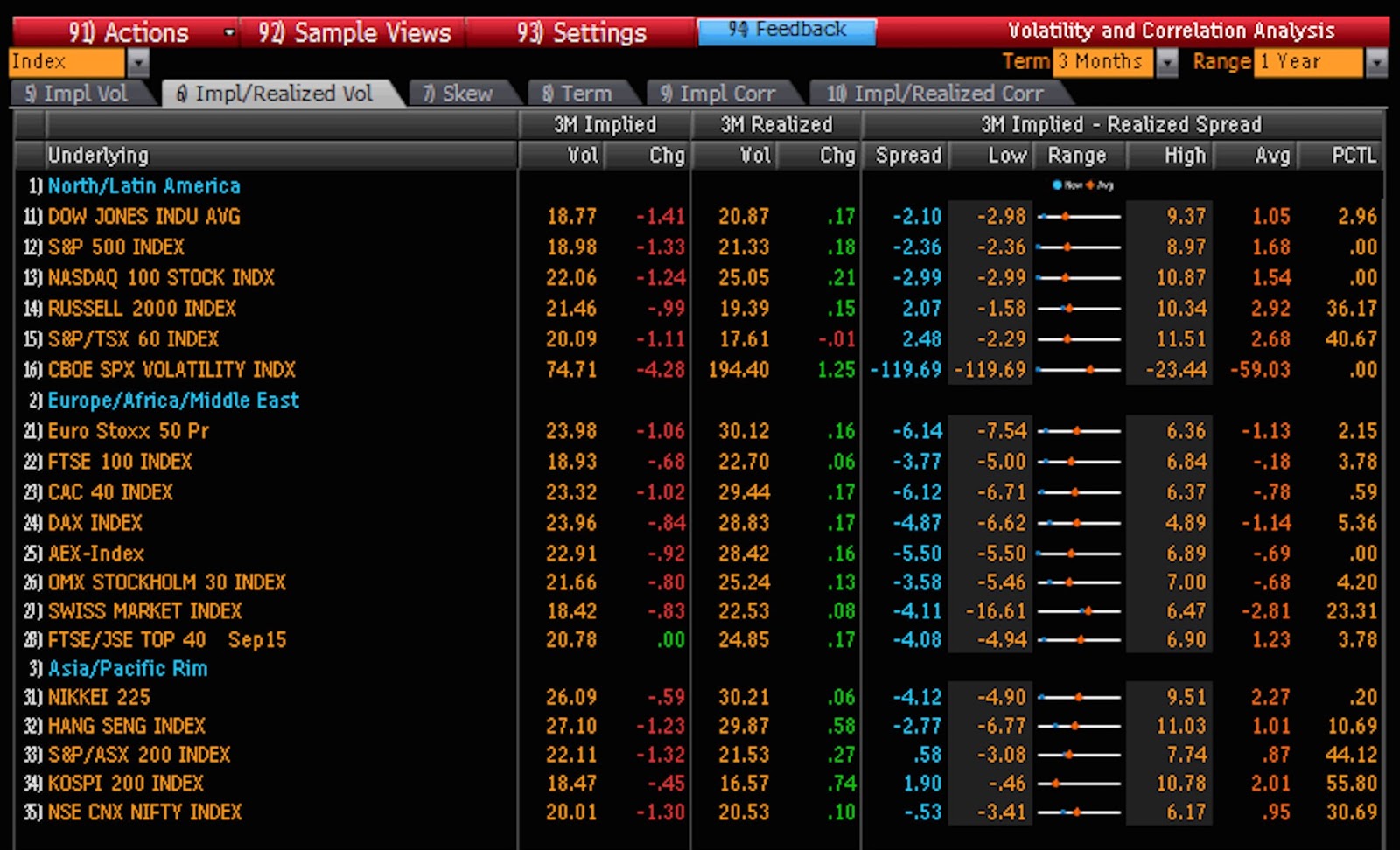
But this doesn't mean that the implieds are too low. It just means that people don't think we will have a blow up similar to August's any time soon. Historic volatility, by it's nature, lags. It's effectively an historic moving average. If it is announced that a currency is to be pegged in a week's time the historic would not reflect the fact that volatility will be 0 until the historic period expired, whilst the implied would probably fall, but not to zero as players would be betting on the chance the peg didn't happen or would blowup, whereas the actual volatility would be 0.
My general point is that using volatility as an indicator is a minefield unless you know exactly what you are looking at. Implied volatility is partly volatility but mostly a huge chunk of estimated probability. Just look at volatility pricing in the USD/Saudi Real which has a volatility of near zero. As with CDS, volatility is crude tool for financial journalists to twist stories of woe from.
We all like to yell and scream at high intraday volatility but the best way to defuse the panic is to apply moving averages. Below is the SPX with 2(green) 5( grey) and 10(red) day moving averages applied.

I know I should be using fibonacci numbers as they are apparently magical but looking at the nice normal 10 day (2 week) we can defuse the whole of September's moves back to 'remarkably dull'. I am predicting that falling actual volatility will undermine positions in implied volatility and with it a reverse pressure on the risk parity funds that have been so cited for vol following trades, to actually start buying back.
I am still not playing the 'it's all going to melt by the end of the week' theme even with the Fed in play.
Oil - There has been a renewed call fro analysts that $20 oil is on the way again with Goldman joining the fray. The last time this happened we saw the base (Shakespear's oil bear witch project). We also have another signal. The tabloids are calling for £1/litre petrol in the UK yet the oil chart doesn't exactly say 'dump' to me.

The majority of assumptions are based on the continuation of trends and that is why so many are wrong.
One last thing - There is a very good WSJ series on Tom Hayes and his case the third instalment of 5 being here - http://graphics.wsj.com/libor-unraveling-tom-hayes/3. the march of the regulator continues and I continue to suggest that if the transparency on pricing demanded of financial institutions were applied to the rest of the retail sector then UK High Streets would, far from being rejuvenated, have to be refitted as jails.
*For financial regulatory news and updates on current cases I recommend following @NewLeafAdvisory on Twitter.


